
You are in: Home, then Guides, then Hospital requests.
How to Request Medical Records from a Hospital
Send a written request to the hospital's health information management (HIM) or release-of-information office, using its form if it has one, with your photo ID. Name the dates and records you want and how you want them delivered. Imaging discs and itemized bills often go to separate departments. The hospital has 30 days under HIPAA, and some states set less.
The plain answer on a hospital medical records request
A hospital chart is held by its HIM department, sometimes called medical records or release of information. Patient portals show part of it. To get the full designated record set you make a formal access request under 45 CFR 164.524, in writing if the hospital requires that. Large systems now take requests online, by fax, by mail and in person, and some route online requests through an outside vendor. Banner Health, for instance, uses MRO Patient Central for online requests from any Banner hospital, office or urgent care.
Steps that work at most hospitals
- Check the portal first. If you only need recent results or a visit summary, the portal may be enough. Grady's MyChart has a "Requested Medical Records" option in the Document Center; Tampa General releases MyChart requests as downloadable PDFs with no fee.
- Find the right office. Multi-hospital systems often run a records office at each campus. Corewell Health lists a separate HIM address, phone, fax and hours for each Southeast Michigan hospital.
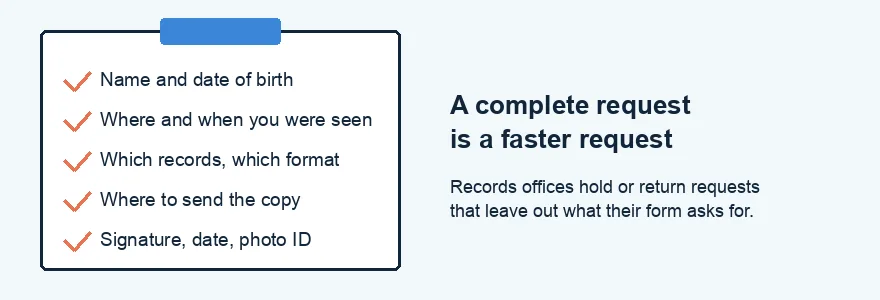
- Use the hospital's form. It tells you what the office needs. If you write your own request, include your full name, date of birth, contact details, the facility, the dates of service, the records you want and how they should be delivered. Tampa General lists exactly these items.
- Sign it the way they require. Tampa General and Corewell Health require a handwritten signature on paper requests. Northwestern Medicine accepts an electronic signature for records sent to you or another provider, but a written signature for anyone else.
- Attach your photo ID. Grady's portal asks you to upload a driver's license or state ID; Banner asks you to have government photo ID ready.
- Send it by a method you can prove. A fax confirmation, portal receipt or tracked mail lets you show when the 30 days started.
- Make separate requests for images and bills if needed. Northwestern sends billing-record requests to its billing line and radiology images on CD; Corewell has dedicated imaging-release contacts; Boston Medical Center handles itemized bills through the same release office.
What hospitals may charge for a hospital medical records request
For your own copy, a HIPAA-covered hospital may charge only reasonable cost-based amounts: copying labor, supplies, postage if mailed, and a summary you agreed to (45 CFR 164.524(c)(4)). In practice, hospitals publish a range of approaches:
- Northwestern Medicine states it does not charge for records sent directly to the patient or to another medical professional, but may bill a non-medical recipient such as an attorney.
- Tampa General states there is no fee for records sent to MyChart or to your doctor's office, and that you will be told the cost before other records are sent.
- Grady states a $6.50 fee to receive records electronically through its portal, and mails an invoice for other requests.
- Banner Health states that a fee may be assessed for labor, supplies or postage, and that you will be told before fees are incurred.
When the copy goes to someone other than you, the state copy-fee law sets the ceiling; see copy fees by state.
Where state law changes the deadline
| Where | Deadline to respond | Citation |
|---|---|---|
| Federal (all HIPAA-covered providers) | 30 days; one extension of up to 30 days with a written reason and date | 45 CFR 164.524(b)(2) |
| Arizona | Promptly; 7 business days generally, but 10 or 15 business days for a patient's request for upcoming treatment and 30 calendar days for other purposes, including litigation | A.R.S. 12-2293(A), (E) |
| Illinois | 30 days; with a written reason, up to 60 days at most | 735 ILCS 5/8-2001(e) |
| Michigan | 30 days (60 if not kept on-site); one 30-day extension with written reasons | MCL 333.26265 |
| Minnesota | 30 calendar days from a written request | Minn. Stat. 144.292, subds. 2, 5 |
| Florida (hospitals) | "In a timely manner, without delays for legal review", only after discharge | Fla. Stat. 395.3025(1) |
| Connecticut (benefit-claim requests) | Within 30 days of the request | Conn. Gen. Stat. 19a-490b(b) |
| Maryland and Missouri | "Within a reasonable time" | Health-General 4-304(a); RSMo 191.227.1 |
State statutes read on official legislature sites, November 13, 2026. Where a state sets a shorter time than HIPAA, the hospital must meet the shorter one.
A request letter you can adapt for a hospital medical records request
If the hospital accepts your own letter, as Tampa General says it does, keep it to one page: "To the Health Information Management Department: Under 45 CFR 164.524, I request a copy of my medical records from [hospital and campus] for [dates of service], specifically [discharge summary, physician and nursing notes, lab and imaging reports]. Please send the copy electronically to [email] (or by mail to [address]). My full name is [name], my date of birth is [date], and a copy of my photo ID is attached. Please tell me in advance of any fee." Sign and date it by hand if the hospital requires a wet signature.
When the copy arrives incomplete
Hospital charts are assembled from many systems, and a first release can miss pieces: emergency department notes, scanned outside records, nursing flowsheets or the imaging itself. Compare what you received against your request and write back listing the gaps by date and type. Under the access rule, the hospital must give you the information in its designated record set, and if part is withheld it must tell you why in writing (45 CFR 164.524(d)). Ask separately for itemized bills, which often sit with patient financial services: Northwestern Medicine, for example, directs billing-record requests to its billing line.
Straight answers on a hospital medical records request
Do I need my medical record number?
It helps the office find you faster, but no federal rule makes it a condition. Your full name, date of birth and dates of service are what forms usually ask for.
Can I pick the records up?
Many hospitals allow it. Northwestern Medicine offers pick-up at certain hospitals, weekdays 8:00 am to 4:30 pm; Corewell Health lists pick-up windows and hours per hospital. Bring photo ID.
I'm still in the hospital. Can I get my chart now?
In Florida the hospital-records statute applies after discharge. Federally, the 30-day clock starts when the request is received; you can ask during the stay, but the chart may still be incomplete.
The hospital wants me to use an online vendor. Do I have to?
Hospitals choose their own intake routes and many offer more than one. If the vendor route does not suit you, ask the HIM office for its paper form and fax or mailing address.
What if the hospital says the record does not exist?
Ask for that in writing. If the hospital knows another place holds the record, it must tell you where to direct the request (45 CFR 164.524(d)(3)).
Our hospital pages collect each system's published routes. If you would like the request prepared and followed up for you, order records-request help.
Rather have someone prepare, send and follow up the request for you?
Start a records request